






Right now, you can take a step toward a career that truly changes the world. Applications are now being accepted for the PAFF and UW School of Education for the 2026/27 academic year. Join the ranks of over 400 people who are making a difference where it’s needed most – in classrooms, during subject lessons, and in their relationships with students.
Free teacher training program
Established in 2015, the School of Education of the Polish-American Freedom Foundation and the University of Warsaw offers a free teacher training program that teaches how to teach: reading and understanding the world, critical thinking, and building positive relationships. It shows how to guide students through the complexities of the modern world, from interpreting cultural texts to solving mathematical problems, from drawing conclusions from the past to reflecting on one’s own development. It also teaches students to carefully observe the world, other people, and themselves. These are competencies that neither a smartphone nor AI can replace – because they are based on relationships, experience, and wise guidance in the learning process.
The teacher training program is organized into four academic tracks:
- Polish Language,
- Biology and Life Sciences,
- History and Social Studies,
- Mathematics.
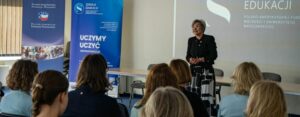
What sets them apart is the most modern model of school-based practical training in Poland. “From the very beginning of their studies, students work in a real school environment—they observe, co-teach classes, and gradually take on responsibility for working with students. They learn by doing, with the support of experienced teachers and tutors who help them develop their own teaching style,” – encourages applicants Marianna Hajdukiewicz, Program Director of the Polish-American Freedom Foundation.
The School of Education was the first in Poland to create its own Teacher Development Standards, a comprehensive tool supporting reflection and the development of teaching competencies. Thanks to these standards, students not only acquire skills but also learn to consciously identify and develop them, which makes them more attentive and effective teachers.
Scholarship and dormitory
The School of Education program is an intensive, tuition-free postgraduate program that combines solid pedagogical training with practical experience and individual professional development. Work takes place in small groups, with an emphasis on dialogue and collaboration, and program participants have the space to develop their potential.
Every student can apply for a scholarship of up to 2,500 PLN per month for the entire duration of the program. In the 2025/26 academic year, over 90 percent of students receive a scholarship. Those from outside Warsaw are also offered free dormitory housing. Thanks to this support, they can focus on acquiring skills that will stay with them for life.
The School of Education is also a community of engaged, curious, and action-oriented people. By joining it, students become part of an environment that supports one another, shares experiences, and collaboratively seeks the best solutions for today’s schools.
Anyone who wants to work with young people and develop their skills in a place that combines theory with practice, reflection with action, and knowledge with relationships can apply to the program, regardless of age or prior professional experience. The requirement is a relevant master’s degree.
Detailed requirements for individual tracks and information on admissions
The School of Education is a joint initiative of the Polish-American Freedom Foundation and the University of Warsaw. Its program was developed in close collaboration with the renowned teacher training center – Columbia University Teachers College in New York. The PAFF and UW School of Education offers Poland’s only free full-time postgraduate program leading to teaching certification.
Over the past 10 years, 415 teachers have been trained, as well as dozens of tutors and mentors supporting the development of other educators. Additionally, over 12,000 teachers and educators have been trained, and outreach activities have reached nearly 25,000 people, demonstrating the broad scale and scope of these initiatives.